
Social Media Linking, Explained
A Small Business Owner’s Guide to Connecting Your Website and Your Social Presence
Why Social Media Linking Matters
Most small businesses treat their website and their social media accounts as two separate projects — a site over here, an Instagram over there, maybe a Facebook page nobody has touched since last spring. But to a customer, it’s all one impression. If those pieces don’t connect cleanly, you’re quietly asking visitors to do the work of stitching your business together themselves. Most won’t bother. (For businesses that have skipped the website entirely and are running on social media alone, our guide to common website mistakes covers why that’s a risky foundation, not just a style choice.)
Social media linking is the practice of making sure your website and your social profiles reinforce each other instead of operating as strangers — so a visitor can move between them without friction, and so what gets shared actually represents you well.
Think of it this way: your website is your storefront and your social profiles are word of mouth — people talking about you at dinner parties, tagging you in photos, sharing your posts. If the storefront and the word of mouth don’t match, or don’t point back to each other, you lose the benefit of both.
Done well, this isn’t just about looking polished. It affects whether people trust you, whether your content spreads, and whether someone who finds you on Instagram ever makes it to your site — or the reverse.
The Six Pillars of Social Media Linking
| Pillar | In Plain English | What We Do About It |
|---|---|---|
| Profile Linking | Do your social icons actually connect to the right, active accounts? | Verified links to every active profile, placed where visitors expect them. |
| Share Previews | Does your link look good when someone pastes it into Facebook or texts it to a friend? | Open Graph and Twitter Card tags set up so shared links show the right image, title, and description. |
| Sharing Buttons | Can visitors easily pass your content along without copy-pasting a link? | One-tap share buttons placed on the pages worth spreading. |
| Consistent Branding | Does your business look like the same business across every platform? | Matching name, logo, colors, and description across all profiles. |
| Social Proof | Are your reviews and social activity visible where new visitors will actually see them? | Embedded feeds, review widgets, or curated highlights placed on the site itself. |
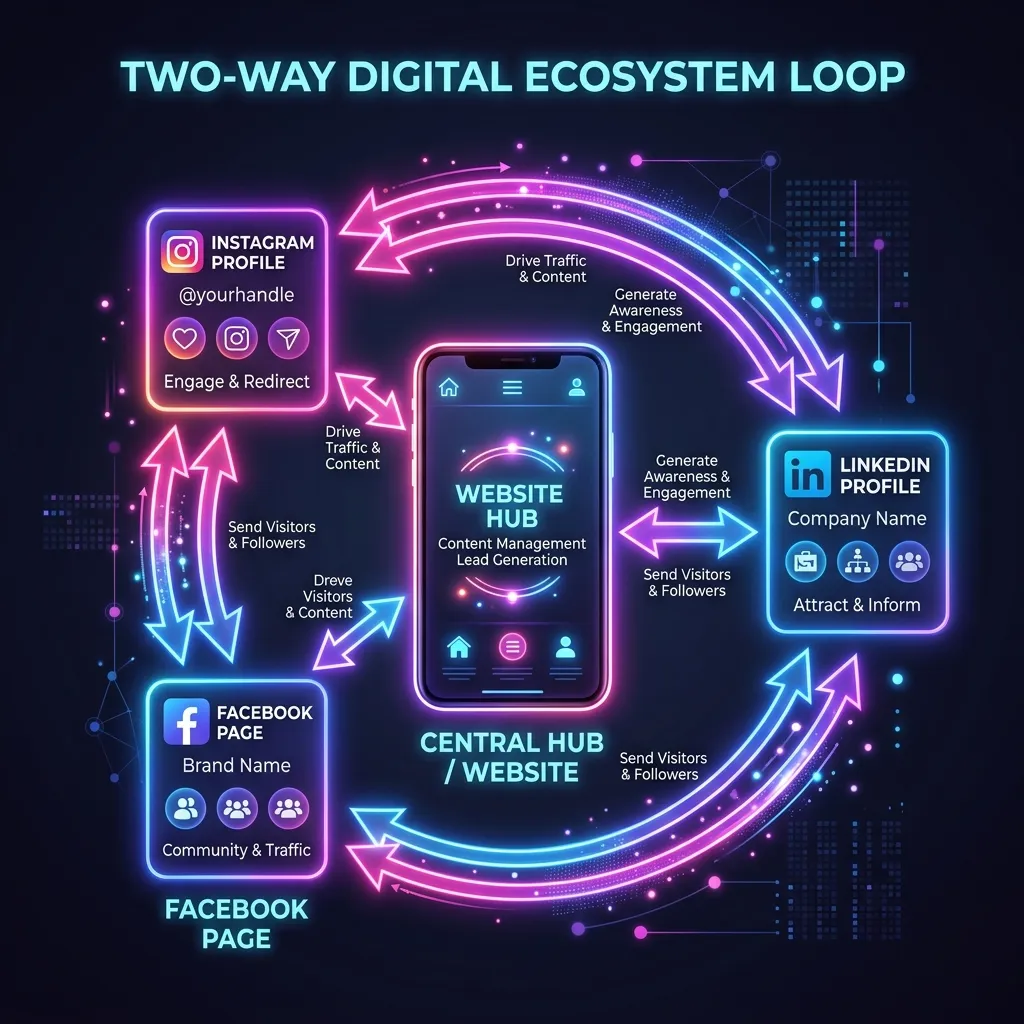
| Cross-Linking | Does your site point people to social, and does social point people back to your site? | A deliberate two-way path between your content and your profiles. |
This is the most basic piece: the icons in your header or footer that lead to your social accounts. It sounds trivial, but broken links, accounts you no longer use, or profiles that are missing entirely are more common than you’d expect — and each one is a small dead end for a visitor who wanted to learn more.
Think of it this way: handing someone a business card with a disconnected phone number. It looks fine until someone actually tries to use it.
2. Share Previews
When someone pastes your link into a text message or a Facebook post, something decides what image, headline, and description show up. Left unconfigured, that preview is often a broken image or the wrong page title — which makes even a great link look untrustworthy before anyone clicks it. This is the same Open Graph setup we cover under “Structured Data” in Technical SEO, Explained — the two overlap right here.
Think of it this way: the display window of your store, except this window is set up automatically by whoever’s walking by. If you don’t design it yourself, you get whatever the platform grabs at random.
3. Sharing Buttons
Even people who love what you’ve written or posted often won’t share it if it takes more than one step. A visible, one-tap share button removes that friction and turns interested visitors into free distribution.
Think of it this way: the difference between asking a happy customer to tell a friend, versus handing them a flyer already addressed and stamped.
4. Consistent Branding
Your logo, colors, business name, and description should match across your website and every social platform. Inconsistency — an old logo on Facebook, a different tagline on Instagram — creates a subtle sense that either the business isn’t well run, or worse, that the profile might not be legitimate.
Think of it this way: wearing a different uniform at every location of the same store. Customers start to wonder if it’s really the same business.
5. Social Proof
Reviews, follower counts, and social activity are trust signals — but only if a visitor to your website actually sees them. Left stranded on a separate platform, that proof does you no good.
Think of it this way: having a wall of thank-you notes from happy customers, but keeping that wall in the back office where no new customer ever walks past it.
6. Cross-Linking
This is the two-way street: your website should point people to active, worthwhile social content, and your social content should reliably point people back to your website when it matters — for booking, buying, or learning more. It’s the same principle behind internal linking, covered in Content Architecture, Explained — just extended out past your own site.
Think of it this way: a well-marked path between two entrances of the same building, so it doesn’t matter which door someone walks in — they can still find their way to the rest of the store.
| Section / Feature | Standard to Meet | Why It Matters |
|---|---|---|
| Profile Bio Link | Direct link to custom landing page (not generic home, unless appropriate) with UTM tracking tags. | Attribute traffic and bookings back to specific social platforms. |
| Branding Visuals | Identical high-res logo and brand color palette on header banners and profile pictures. | Build immediate brand recognition and professional trust. |
| Contact Buttons | Enabled and verified 'Call', 'Email', or 'Book' actions that match website contact info. | Remove friction for users trying to contact you directly from profiles. |
| About / Description | Consistent 1-2 sentence value proposition outlining services and service area. | Helps platform search algorithms and visitors understand what you do in 3 seconds. |
| Pinned Content | Pinned post with current offer, review compilation, or a "How to Work with Us" guide. | Ensure first-time profile visitors see your highest-value message immediately. |
Our Process at Risal Systems
Here’s how we approach connecting a client’s website and social presence.
Step 1 — Audit
- We check every social link, every share preview, and every point of contact between your site and your profiles.
- We note where branding is inconsistent or where profiles are stale, broken, or missing.
Step 2 — Prioritize
- We focus first on the platforms your actual customers use — not every platform that exists.
Step 3 — Connect
- We implement clean profile links, correct share previews, sharing buttons, and any social proof placements that make sense for your site.
Step 4 — Maintain
- As you add new content or update your branding, we keep both sides — site and social — in sync.
The aim is a business that looks like one coherent thing, no matter where someone first encounters it.
What This Means for Your Business
Social media linking doesn’t generate traffic by itself — it makes sure the traffic and attention you already earn doesn’t leak out through broken connections. For a small business, that means:
- Visitors who find you on social media can actually make it to your site to book or buy.
- Content you’re proud of looks right when it’s shared, instead of undermining itself with a broken preview.
- Your business presents as one consistent, trustworthy brand — not a scattered set of half-updated profiles.
- Happy customers have an easy path to spread the word for you.
Like technical SEO, this is largely invisible when it’s working — and quietly costly when it isn’t.
Getting Started
If you’re not sure how well your site and social profiles currently work together, that’s an easy thing to check. A short review will show you exactly what’s connected, what’s broken, and what’s worth fixing first.
Reach out to Risal Systems and we’ll walk you through it in plain language, step by step.
Related reading: