
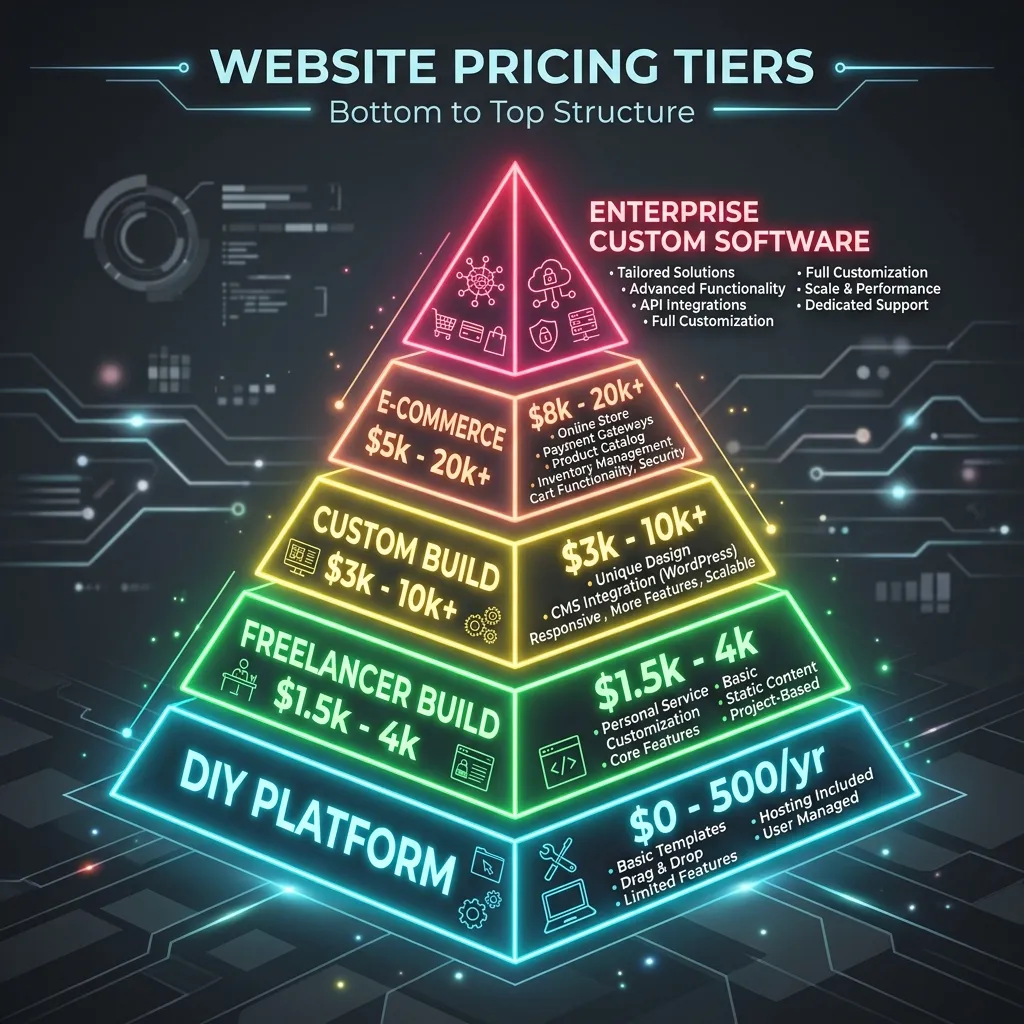
The Quick Reference
| Option | Typical Cost | Best For |
|---|---|---|
| DIY / Template Platform | $0 – $500/yr | Testing an idea, zero budget |
| Freelancer / Entry-Level | $1,500 – $4,000 | Better than DIY, moderate budget |
| Custom Build | $3,000 – $10,000+ | Lead generation, serious growth |
| E-Commerce | $5,000 – $20,000+ | Selling products online |
| Custom Software / Automation | $8,000 – $30,000+ | Complex workflows, booking systems |
Option 1: DIY / Template Platforms ($0 – $500/year)
Platforms like Wix, Squarespace, and Google Sites let you build something yourself for little to no cost beyond an annual subscription.
What you get
A site that exists. You control it, you update it, and you’re responsible for making it look right.
What you don’t get
Speed optimization, local SEO setup, schema markup, custom functionality, or a design that stands out from the thousands of other businesses using the same Wix template. Google also treats template-built sites differently — they tend to score lower on Core Web Vitals, which affects rankings.
When it makes sense
You’re testing a business idea, you have no budget, or your web presence genuinely doesn’t drive customer acquisition. A plumber who gets every job from direct referrals doesn’t need a $5,000 website. A plumber trying to rank on Google does.
Option 2: Freelancer / Entry-Level Agency ($1,500 – $4,000)
A freelancer or small studio builds something using a WordPress theme, a website builder with customization, or a lightweight framework.
What you get
A site that looks more professional than a pure template, basic SEO setup, and someone to contact when things break.
What you don’t get
Guaranteed performance optimization, custom functionality, proper schema markup, or consistent ongoing support. At this price point, quality varies enormously. “I’ll build you a website” covers a very wide range of actual outcomes.
When it makes sense
You need something better than DIY but your budget is limited. If you go this route, be specific about deliverables before signing anything — get page speed scores, SEO setup, and what’s included in writing.
Option 3: Custom-Built Site ($3,000 – $10,000+)
A development team builds your site from scratch — no template, no theme, everything designed and coded specifically for your business and its goals.
What you get
A site that loads fast, looks exactly how your brand needs it to look, has local SEO structure built in from day one, and is designed to generate leads rather than just exist. Schema markup, performance optimization, mobile responsiveness, and accessibility are handled as part of the build — not afterthoughts.
What drives the price up in this tier
- Number of pages and service areas
- Custom design vs. adapted brand guidelines
- Contact forms vs. full booking or quote systems
- Ongoing maintenance and support included vs. one-time build
When it makes sense
Your website is a meaningful part of how you acquire customers. If a well-built site generates one additional commercial contract per month, it pays for itself quickly. Duke’s Professional Cleaning Services, for example, reached position 8 on Google within 90 days of launch — with no ad spend.
A correctly-built site is an asset that compounds over time. A $500 template generally doesn’t rank, doesn’t convert, and doesn’t grow with your business.
Option 4: E-Commerce ($5,000 – $20,000+)
An online store with product management, payment processing, inventory tracking, and the surrounding customer experience.
What you get
A secure, functional store your customers can actually use without frustration — with proper checkout flow, product pages optimized for both conversion and search, and a backend you or your team can manage.
What drives e-commerce costs up
- Number of products and categories
- Payment gateway integration (Stripe, PayPal, etc.)
- Inventory management complexity
- Custom product configurators or subscription logic
- Integration with existing POS or fulfillment systems
When it makes sense
You’re selling products and want to own the customer relationship rather than paying platform fees to Etsy, Amazon, or Shopify forever. For businesses with consistent product volume, a custom store typically pays for itself within 12–18 months versus ongoing platform fees. See our Growth Engine page for what a build in this tier typically includes.
What Affects Website Cost the Most?
Across every price point, these are the variables that move the number most:
- Functionality scope — a contact form is fundamentally different from a booking system, which is different from a payment gateway. Each adds time and therefore cost.
- Timeline — rushed builds cost more. A 2-week turnaround versus a 6-week project reflects real differences in resource allocation.
- Ongoing support — a one-time build with no maintenance is less expensive upfront but creates risk. Hosting breaks, plugins conflict, content needs updating.
- SEO depth — basic meta tags are fast. Full schema markup and local SEO signals, Core Web Vitals optimization, and sitemap configuration take longer and are worth it if rankings matter to your business.
- Content — if you supply the copy and images, the build is faster and cheaper. If the agency is writing content and sourcing visuals, that’s additional scope.
What About Ongoing Costs?
The build price is only part of the picture. Plan for these recurring costs regardless of who builds your site:
- Domain name — ~$15–20/year through Google Domains, Namecheap, or similar
- Hosting — $0–50/month depending on platform. Static sites on Netlify can be free; managed WordPress hosting runs $20–50/month; VPS for custom apps runs higher.
- SSL certificate — usually included with hosting, but verify. A site without HTTPS is penalized in search rankings.
- Maintenance — plan for occasional updates, security patches, and content changes. Either budget your developer’s hourly rate or factor in a monthly retainer.
What Does Risal Systems Charge?
We build custom sites and don’t use templates — so we’re not the cheapest option in Georgia. Our projects typically start around $3,000 for a focused lead-generation site and scale from there based on complexity, number of pages, and the SEO depth required.
What we can tell you plainly: a correctly-built site is worth more than it costs if your business relies on local search visibility. Duke’s Professional Cleaning Services is averaging position 8 on Google within 90 days of launch with no ad spend. That kind of result compounds month over month.
The first consultation is free. We’ll review your current online presence, tell you what we’d recommend, and give you a clear quote — no vague “it depends” without specifics.
If your project involves more than a brochure site — booking systems, inventory, or customer follow-up — see our Operational Efficiency page for what that adds to the scope. And if you want the deeper numbers behind why the cheapest option often isn’t the cheapest, read our three-year cost analysis of template vs. custom sites.
Related reading:
- Web Development Resource Hub
- Modular vs. Custom Website Cost
- How Long Does a Small Business Website Take to Build?
- Common Website Mistakes Stopping Small Businesses From Growing
Get a straight answer on what your project would cost
Free consultation. No sales pressure. We'll tell you what we'd build and what it would cost before you commit to anything.