
Modular vs. Custom Website: What’s the Real Difference?
When you are building a home, the difference between a modular prefab and a custom architect-designed build is obvious on paper. The modular home is cheaper upfront, faster to deliver, and looks perfectly fine from the street. The custom home costs more, takes longer, and requires a real engineer to get right. Most people understand intuitively that these are not the same product — even if both technically keep the rain out.
What most people do not see immediately is what happens over time. The modular home depreciates faster, costs more to modify, limits what you can do with the space, and locks you into a builder’s standard components whether they fit your needs or not. The custom home holds its value, adapts to your requirements, and performs the way it was designed to perform — because it was engineered for you, not for a catalog.
Your website is this exact same decision. And most business owners make it without realising they are making it at all.
Wix, Shopify, and WordPress are modular homes. They are pre-engineered platforms where your business moves into someone else’s structural framework. A custom-built website — engineered from the ground up for your business, your customers, and your specific conversion flow — is the architect-designed build. It costs more on day one. It performs better on every day after.
The question this analysis answers is: how much better, and does the difference actually matter to your bottom line?
Wix vs. Shopify vs. WordPress vs. Custom: How Do They Compare?
To make this concrete, imagine four limousine companies operating in the same metro market. Each owner invested in a 12-page professional website with the same core functionality: a fare calculator, a contact form, service pages, and booking information. Each company draws approximately 1,500 unique monthly visitors through organic search, Google Ads, and referrals. Each qualified lead is conservatively worth $125 in revenue opportunity.
The only meaningful difference between these four businesses is the technology their websites run on.
| Factor | Wix | Shopify | WordPress | Custom (Static) |
|---|---|---|---|---|
| Platform | Wix Business | Shopify Basic + apps | Self-hosted WP | Netlify / Vercel |
| Build cost | $2,000 | $3,000 | $3,500 | $4,000 |
| Monthly platform cost | $32 | $50 | $110 | $19 |
| Mobile PageSpeed score | 58 | 62 | 52 | 85 |
| Estimated mobile load time | ~5.5 sec | ~4.8 sec | ~6.2 sec | ~2.8 sec |
These performance scores reflect published benchmarks and independent testing across thousands of real sites. Wix averages 58–65 on mobile PageSpeed. Typical Shopify stores score 55–65 before app bloat pulls them lower. Unoptimized WordPress sites for small businesses frequently score below 55. A well-built static custom site routinely scores 80–90.
Why Does Website Speed Matter for Business Revenue?
Most business owners are told that site speed matters for SEO. Few are shown how directly it affects revenue.
of mobile users abandon a website that takes longer than 3 seconds to load. — Google
That is not a statistic about frustrated tech users. That is more than half of your potential customers leaving before they see a single word about your services. The bounce rate data — the percentage of visitors who leave without taking any action — tells the same story:
| Load Time | Bounce Rate | Visitors Who Stay (per 1,500/mo) | Monthly Opportunity Lost |
|---|---|---|---|
| Under 3 seconds | ~40% | 900 | Baseline |
| ~4.8 seconds | ~55% | 675 | 225 visitors lost |
| ~5.5 seconds | ~62% | 570 | 330 visitors lost |
| ~6.2 seconds | ~68% | 480 | 420 visitors lost |
A visitor who bounces generates zero revenue. They never see your fleet. They never read your reviews. They never find your fare calculator. They leave — and in most cases, go directly to a competitor whose site loaded faster.
reduction in conversions for every one-second delay in mobile load time. — Google / Deloitte
How Much Revenue Does a Slow Website Cost Over Three Years?
Monthly unique visitors: 1,500 | Lead value: $125 per qualified inquiry | Period: 36 months
Conversion rate of engaged visitors is held at 5% across all platforms. The variable is how many visitors stay long enough to engage — which is driven entirely by load speed.
Monthly Lead Generation by Platform
| Metric | Wix | Shopify | WordPress | Custom |
|---|---|---|---|---|
| Monthly visitors | 1,500 | 1,500 | 1,500 | 1,500 |
| Bounce rate | 62% | 55% | 68% | 40% |
| Engaged visitors | 570 | 675 | 480 | 900 |
| Conversion rate | 5% | 5% | 5% | 5% |
| Monthly leads | 29 | 34 | 24 | 45 |
| Monthly revenue opportunity | $3,625 | $4,250 | $3,000 | $5,625 |
That is the cost of a slower website — not in server fees or plugin subscriptions, but in leads that arrived and left without converting.
Revenue Gap vs. Custom Site
| Platform | Monthly Shortfall | Annual Shortfall | 3-Year Shortfall |
|---|---|---|---|
| Shopify | -$1,375 | -$16,500 | -$49,500 |
| Wix | -$2,000 | -$24,000 | -$72,000 |
| WordPress | -$2,625 | -$31,500 | -$94,500 |
Three-Year Total Cost of Ownership
WordPress’s monthly cost of $110 reflects managed hosting ($30) + essential premium plugins for security, backups, SEO, and performance ($30) + basic maintenance time (~$50). Patchstack’s 2025 report identified over 6,700 new WordPress vulnerabilities in a single six-month period — a security incident is not hypothetical, it’s a near-certainty over three years.
| Cost Factor | Wix | Shopify | WordPress | Custom |
|---|---|---|---|---|
| Build cost | $2,000 | $3,000 | $3,500 | $4,000 |
| Monthly cost | $32 | $50 | $110 | $19 |
| 36-month fees | $1,152 | $1,800 | $3,960 | $684 |
| Security incident (est.) | — | — | $750 | — |
| 3-Year Total Cost | $3,152 | $4,800 | $8,210 | $4,684 |
The Complete Picture
| Summary | Wix | Shopify | WordPress | Custom |
|---|---|---|---|---|
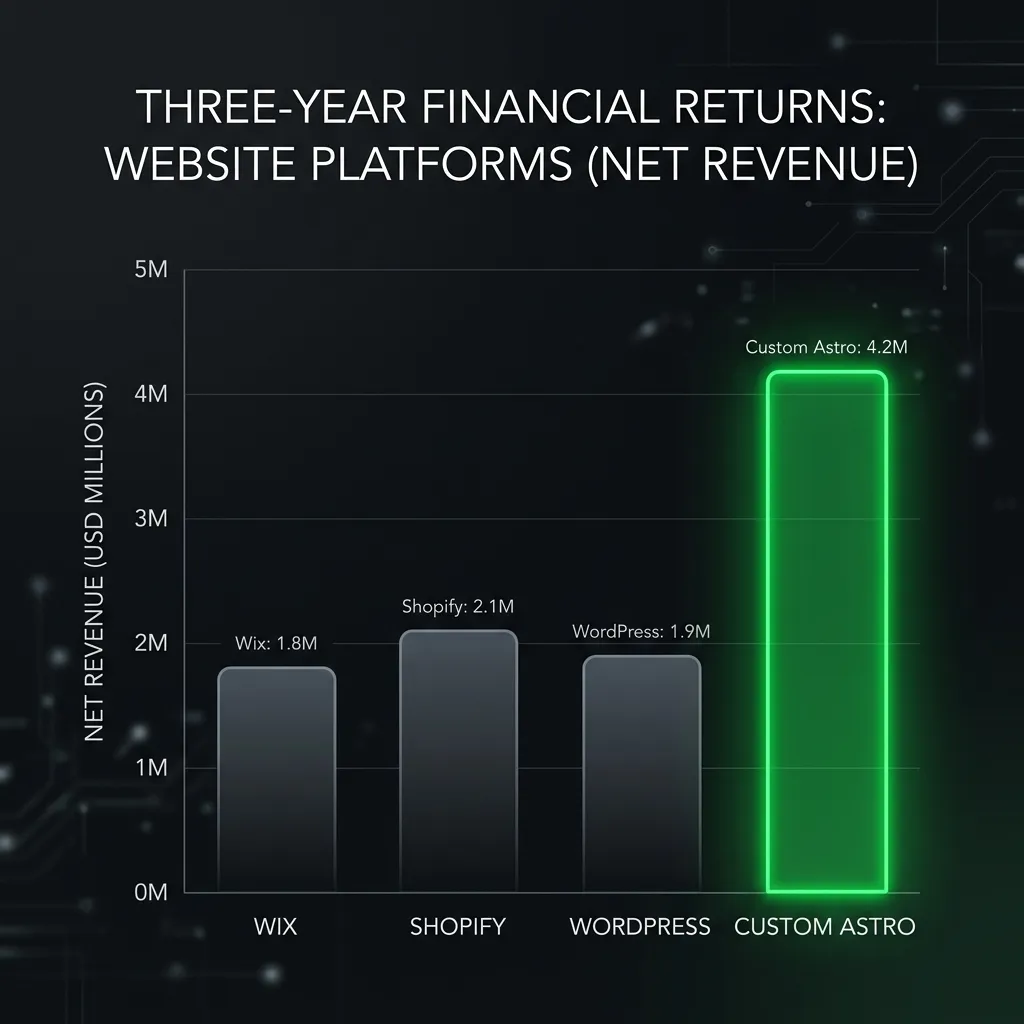
| 3-Year revenue opportunity | $130,500 | $153,000 | $108,000 | $202,500 |
| 3-Year total cost | $3,152 | $4,800 | $8,210 | $4,684 |
| 3-Year net position | $127,348 | $148,200 | $99,790 | $197,816 |
| Gap vs. Custom | -$70,468 | -$49,616 | -$98,026 | — |
The custom site — despite costing $4,000 to build — generates between $49,000 and $98,000 more in revenue opportunity over three years than its template counterparts. WordPress, often chosen for flexibility, produces the worst overall outcome once maintenance costs and conversion losses are combined.
What Hidden Costs Come With Template Websites?
Time. WordPress and Shopify both demand ongoing attention: plugin updates, compatibility conflicts, theme patches, performance monitoring. For a business owner who values their time at $75 an hour, even three hours of self-managed maintenance per month adds $2,700 to the three-year WordPress cost — not included in the model above.
Vendor lock-in. Wix and Shopify do not allow you to export a fully portable website. If you want to leave, you rebuild from scratch. Custom-built static sites can be moved to any host in minutes, because you own the code outright.
SEO compounding. Google’s Core Web Vitals are now a direct ranking factor. A site scoring 85 on mobile PageSpeed does not just convert better — it ranks higher, attracting more organic traffic over time. The performance gap widens as Google increasingly rewards speed. See our SEO and local search page for how we build that in from the start.
The fare calculator difference. Among our four companies, only the custom site has a truly integrated fare calculator — built natively in JavaScript, designed for the exact pricing logic of that business, and embedded seamlessly into the booking flow. The other three use third-party widgets or plugins that add HTTP requests, introduce load delays, and create UX inconsistencies. A native tool is a conversion asset. A bolted-on plugin is a compromise.
What Do You Actually Get With a Custom Website?
When a homeowner commissions a custom build, they are not paying for nicer trim. They are paying for a structure engineered to their land, their needs, and their future — not forced into a standard floor plan designed for the builder’s convenience.
When a business pays $4,000 for a custom static site, the same logic applies. They are not paying for a prettier template. They are buying:
- Performance as a foundation, not an afterthought. A static site on a CDN has no database queries, no plugin conflicts, no server-side rendering delay. Pages load in under 3 seconds on mobile because there is nothing in the way.
- $19-per-month infrastructure. [Netlify](/growth-engine) and Vercel are enterprise-grade platforms used by companies like Twilio and HashiCorp. Global CDN, automatic SSL, instant rollback, and 99.99% uptime SLAs — for less than a streaming subscription.
- Ownership. The code belongs to the business. It can be moved, modified, and expanded without platform permission or vendor negotiation.
- No maintenance tax. No plugins to update, no compatibility matrices to manage, no CMS vulnerabilities to patch. Static files do not get hacked.
Why Choose Custom: The Plain Business Case
Comparing build costs without comparing performance outcomes is like evaluating two homes by their asking price alone, ignoring resale value, maintenance costs, and how well they actually fit the family living in them. The number that matters is not what you pay on day one — it is what the asset produces over time.
For a limousine service drawing 1,500 visitors a month, with leads worth $125 each, the difference between a mobile PageSpeed score of 52 and a score of 85 is approximately $70,000 to $98,000 over three years. That is the gap between the modular option and the custom build. And just like in construction, the custom build costs more at the start and less in every year that follows.
The cheapest website is the one that converts. The cheapest home is the one that holds its value. Same principle — different industry.
For a breakdown of what each price tier actually includes, see our website cost guide for Georgia small businesses. And for a real example of a custom static build in production, see how we built Posh Limousines of Atlanta’s full digital infrastructure.
Related reading:
- Web Development Resource Hub
- Georgia Website Cost Guide
- How Long Does a Small Business Website Take to Build?
- Common Website Mistakes Stopping Small Businesses From Growing
See the Numbers for Your Business
We'll build a three-year model using your traffic, your lead value, and your market — so you can make this decision with real data, not guesswork.
Performance data sourced from Google/Deloitte consumer research, Patchstack 2025 WordPress Vulnerability Report, independent platform benchmarking by PandaCodeGen (2026), Shero Commerce Shopify Speed Benchmarks (2025), and published Google PageSpeed Insights methodology. Monthly platform pricing reflects 2026 published rates. Financial projections are illustrative models based on published industry conversion benchmarks. Individual results will vary.